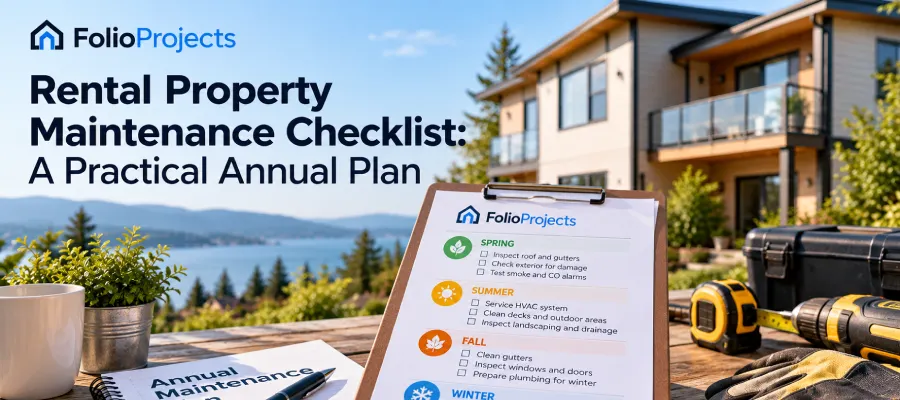
A rental property maintenance schedule should do more than remind an owner to clean gutters. It should identify the building systems that need attention, the conditions that could lead to expensive failures, and the records that demonstrate what work was actually completed. For landlords managing multiple units, consistency matters as much as the individual tasks.
This guide provides a practical annual framework for Canadian rental property owners. The suggested intervals are planning prompts, not mandatory inspection frequencies. Adjust them for equipment manuals, the age and condition of the property, local climate, tenancy arrangements, insurer requirements, and applicable law. Where a task involves electrical, gas, structural, fire-safety, or other regulated work, use an appropriately qualified professional.
Free resources: Build a customized plan with the Property Maintenance Schedule Generator, download the maintenance schedule and work log (Excel), or print the rental property maintenance checklist (PDF).
1. Start with the building, not a generic calendar
The right schedule for a newer condominium is different from the schedule for a 1970s duplex with an aging roof and multiple heating systems. Begin by documenting what is actually installed. A system inventory should identify the component, its location, known age, manufacturer, maintenance requirements, condition, and the person responsible for servicing it. If the installation date is unknown, mark it unknown rather than substituting an estimate that could later be mistaken for a fact.
Review past inspection reports, contractor invoices, insurance recommendations, recurring tenant complaints, and warranties. These documents can reveal problems that a simple checklist will miss. For example, repeated moisture staining near a window may justify targeted investigation even when the annual exterior inspection is not yet due.
| Inventory field | Illustrative duplex entry | Why it matters |
|---|---|---|
| System | Heat pump, Unit A | Connects work to a specific asset |
| Location | Exterior east wall / living room | Helps contractors identify equipment |
| Installation year | 2021, invoice confirmed | Supports warranty and replacement planning |
| Maintenance basis | Manufacturer manual | Avoids invented service intervals |
| Next action | Arrange qualified service | Creates a responsible follow-up |
For each item, distinguish routine owner observations from tasks requiring professional servicing. A visual check for water staining is not equivalent to a plumbing inspection. A landlord observing a smoke alarm indicator is not a substitute for any legally required testing, inspection, or replacement.
2. Monthly and recurring maintenance checks
Monthly reviews are most useful when they are short, repeatable, and based on observable issues. A property owner or manager might review open maintenance requests, recent leaks, unusual energy or water consumption, access concerns, and unresolved deficiencies. The goal is to catch changes before they become expensive, not to inspect every system every month.
- Water and moisture: review reported leaks, condensation, water stains, drainage concerns, and any unresolved plumbing issues.
- Heating and ventilation: check reported comfort issues and follow the manufacturer’s filter and service instructions.
- Life-safety equipment: maintain the applicable smoke and carbon monoxide alarm program according to local requirements and device instructions.
- Exterior and common areas: review reported trip hazards, damaged lighting, blocked access, and deteriorating surfaces.
- Records: close completed requests with dates, work descriptions, contractor information, and supporting evidence.
Tenant access and responsibility must be handled appropriately. In British Columbia, for example, landlord entry is subject to residential tenancy rules; a maintenance calendar does not override notice requirements or create unrestricted inspection rights. Use the BC Residential Tenancy Branch as a starting point for current provincial guidance, and verify the rules that apply to the property.
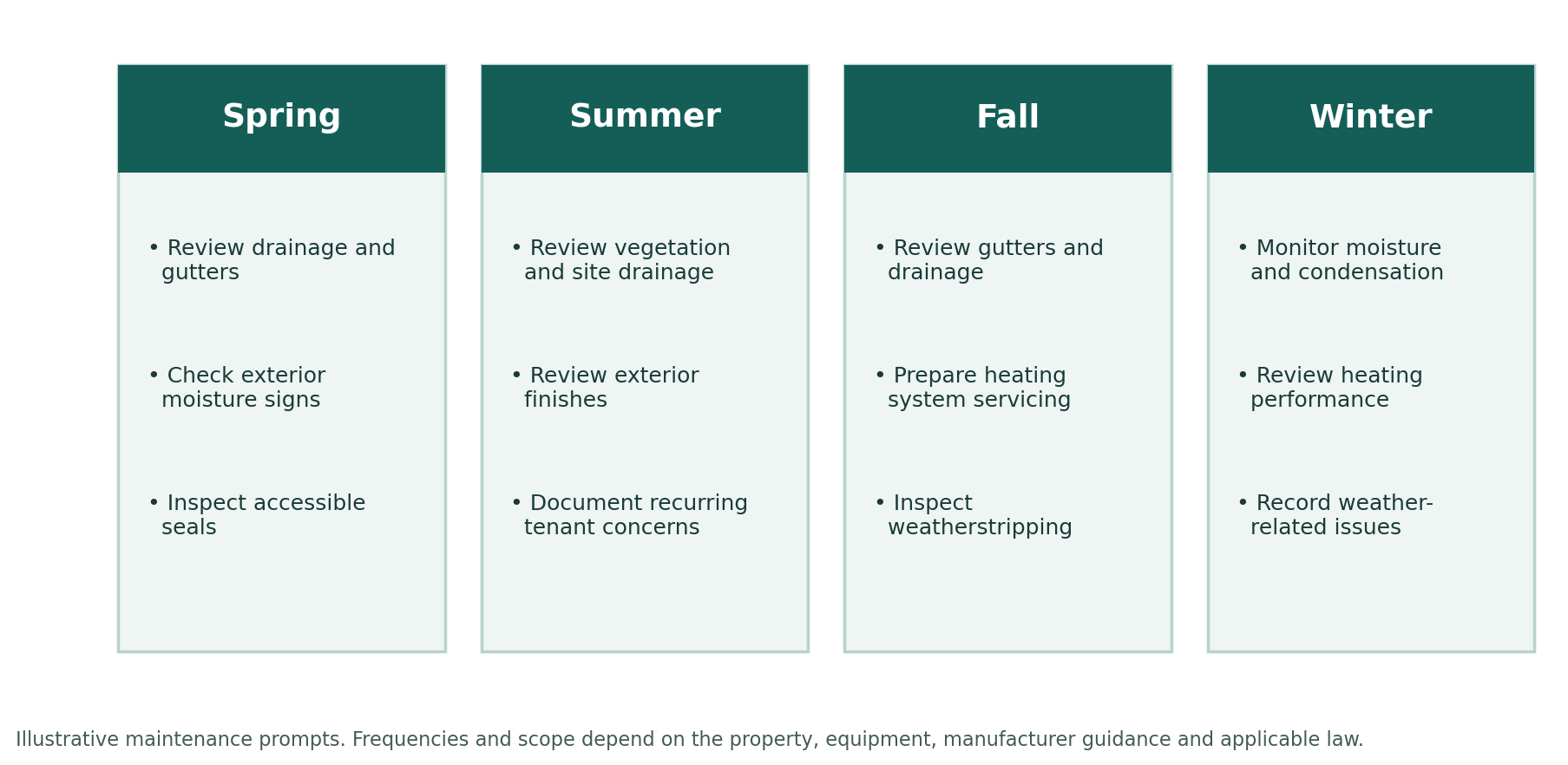
3. Spring: investigate water, drainage, and winter damage
Spring is a useful time to review the effects of winter weather. Water management deserves particular attention because an apparently small drainage problem can affect foundations, cladding, interior finishes, and tenant comfort. Look for signs of ponding, overflow, damaged downspouts, or moisture entering the building. Do not assume that a dry-looking interior rules out hidden damage.
- Review visible roof edges, gutters, and downspouts from safe accessible locations; arrange professional roof access when necessary.
- Check that surface drainage routes are not blocked and that water is directed appropriately away from the building.
- Document exterior cracking, displaced materials, failed sealant, and staining that could warrant investigation.
- Review landscaping, retaining structures, paths, and exterior steps for winter damage.
- Revisit any moisture-related complaints reported during the wet season.
Where a building has a history of water ingress, record the location, date, weather conditions, photographs, and corrective work. Comparing observations over several years can reveal a pattern that isolated repair invoices would not show. Do not perform roof work, ladder work, or hazardous access tasks without appropriate expertise and safety controls.
4. Summer: plan repairs and larger projects
Summer often provides a practical window for exterior projects, although contractor availability, wildfire smoke, heat, municipal restrictions, and local conditions may affect timing. Use this period to obtain quotations for planned improvements and resolve issues identified during spring reviews. Keep urgent repairs separate from discretionary upgrades so that cosmetic work does not displace safety or building-envelope priorities.
For significant work, establish a written scope and compare quotations on the same basis. A lower bid may exclude permits, disposal, access equipment, restoration, or commissioning. Record the approved budget and any change orders separately from the final invoice. This information will help with both ongoing maintenance and future capital planning.
If the work replaces a major building component, update the asset inventory when it is complete. Record what was installed, which areas were affected, the warranty terms, and when future service is expected. For a detailed approach to documenting major upgrades, see How to Track Capital Improvements on Investment Properties.
5. Autumn: prepare for wet and cold conditions
Autumn planning should focus on weather exposure, heating reliability, drainage, and access. In coastal British Columbia, prolonged wet weather can make small envelope or drainage deficiencies more consequential. In colder regions, freeze protection and heating reliability may deserve additional attention. Use local conditions rather than treating every property in Canada as having the same seasonal risks.
- Confirm that heating systems have received required servicing and that reported performance issues have been addressed.
- Review roof-drainage and ground-drainage concerns before heavy precipitation.
- Inspect accessible door and window seals for visible deterioration and record drafts or moisture complaints.
- Review exterior lighting, walkways, handrails, and access routes for seasonal safety concerns.
- Confirm that emergency contacts, contractor details, and procedures for urgent repairs are current.
An autumn review is also a good time to confirm whether winter work will require tenant coordination, temporary heating, or advance scheduling. A schedule is useful only when the owner can actually complete the work without creating avoidable disruption.
6. Winter: monitor performance and respond to incidents
Winter maintenance emphasizes monitoring and response. Track heating failures, condensation, ice-related hazards, roof leaks, and plumbing concerns according to the property’s exposure and climate. Record the timing of incidents and the conditions under which they occur. A recurring leak during wind-driven rain, for example, may point to a different cause than a leak that appears only during plumbing use.
When an incident occurs, document the immediate protective measures, affected areas, contractor findings, repair decisions, and follow-up checks. A complete record should distinguish temporary mitigation from permanent correction. If a leak is stopped with a short-term repair, the underlying deficiency should remain visible until the root cause is addressed.
7. Turn maintenance observations into an annual schedule
Rather than scheduling every possible task on January 1, organize work into recurring checks, seasonal reviews, manufacturer-required service, and condition-triggered actions. The following table is a planning example, not a prescribed maintenance standard.
| Timing | Example work | Completion evidence |
|---|---|---|
| Monthly or as reported | Review unresolved leaks, comfort complaints, and safety concerns | Request log and follow-up notes |
| Spring | Review drainage and visible winter damage | Dated photographs and findings |
| Summer | Coordinate planned exterior repairs and contractor work | Approved scope and final invoices |
| Autumn | Review heating readiness, drainage, and weather exposure | Service documentation and checklist |
| Winter | Monitor performance and document incidents | Incident log and corrective actions |
| Annually | Review systems inventory, warranties, and replacement priorities | Updated asset register and capital forecast |
Make a schedule tailored to your building: The free Property Maintenance Schedule Generator can help organize tasks by system and season. Review the suggested intervals before relying on them. Download the Excel maintenance log if you prefer to track the work offline.
8. Record findings, not just completed tasks
A checked box proves very little by itself. Useful maintenance records identify the property, component, observation, action taken, date, responsible person, and supporting evidence. When a contractor performs the work, retain the scope, invoice, and relevant service report. If the work is incomplete, record the next action and due date rather than marking it closed.
A simple findings register can use four states: new, under investigation, action planned, and resolved. Record urgency separately from status. A minor cosmetic issue can remain open without being an emergency, while an active leak may require immediate response even before its cause is confirmed.
| Finding | Evidence | Action | Status |
|---|---|---|---|
| Water stain below window | Photo and tenant report | Arrange building-envelope assessment | Under investigation |
| Heat pump noise | Service request and model number | Qualified technician review | Action planned |
| Blocked downspout | Dated photograph | Clear obstruction safely; confirm drainage | Resolved |
The purpose of this record is continuity. When a tenant changes, a contractor retires, or the property is sold, the owner should not have to reconstruct the building’s history from memory.
9. Connect maintenance to capital expenditure planning
Maintenance and capital improvements are related but not interchangeable. A service visit may extend equipment life or reveal that replacement is becoming necessary. When repeated repairs indicate declining reliability, record the finding against the affected system and update the estimated replacement year. That information belongs in a capital plan, not only in the annual maintenance budget.
For example, suppose an owner spends $800 servicing an older heating unit and receives a recommendation to replace it within three years. The $800 service expenditure and the estimated replacement cost answer different questions. The service record explains what happened this year; the capital forecast helps the owner prepare for the future.
Use the Capital Expenditure Planner to model anticipated system replacements and reserve funding. Keep the estimates current as actual condition assessments and contractor quotations become available.
10. Create a repeatable maintenance closeout process
A maintenance program works best when every completed job follows the same short closeout routine. Confirm what was done, whether the original issue was resolved, which evidence was retained, whether another inspection is needed, and whether the asset inventory or capital forecast should change. For major work, note warranty conditions and service requirements.
- Record the completion date and the person or contractor who performed the work.
- Preserve invoices, service reports, relevant photographs, and approvals.
- Identify unresolved issues and assign the next action.
- Update the building system record if equipment or components changed.
- Schedule any follow-up inspections or manufacturer-required servicing.
- Review recurring problems at least annually to identify replacement priorities.
Download the printable maintenance checklist (PDF) to support seasonal reviews and project closeout. The companion Excel workbook provides a structured place to record tasks, findings, and completed work.
11. Organize maintenance across multiple properties
When a portfolio grows, consistent categories and evidence become more valuable than elaborate calendars. Use common names for roofing, plumbing, HVAC, electrical, building envelope, site drainage, and appliances. Maintain property-specific details beneath those categories. This makes it easier to identify recurring failures, compare contractor performance, and see where capital requirements may be accumulating.
FolioProjects is designed to keep property systems, projects, documents, and supporting evidence connected to the relevant property. That persistent record can complement accounting or rent-collection software by retaining information about the physical building. Owners can explore FolioProjects pricing or review how to set up a property when they are ready to move beyond standalone checklists.
12. Annual maintenance review checklist
- Confirm the property and systems inventory is current, including equipment changes.
- Review open findings and recurring problems, not only completed tasks.
- Check that applicable service, safety, and inspection requirements are being met.
- Revisit seasonal tasks in light of climate, occupancy, and building condition.
- Update contractor contacts, warranty details, and emergency procedures.
- Review repair spending alongside the five-year capital replacement forecast.
- Archive the annual checklist and supporting documents with the property record.
Next step: Generate a property maintenance schedule, then use the maintenance log to record what actually happens. The value is not the calendar alone; it is the building history you maintain over time.