Owning several properties does not simply create more versions of the same decision. One property may have unused development potential. Another may need a repair before a small deficiency becomes a major loss. A third may be operating well and require very little owner attention. A fourth may have reached the point where its value is more useful as capital for another opportunity.
The portfolio question is not, “What can I do with this property?” Almost every property can absorb more planning, more construction, more management or more marketing. The useful question is, “What does this property need next, based on my goals, the evidence and the alternatives competing for the same resources?”
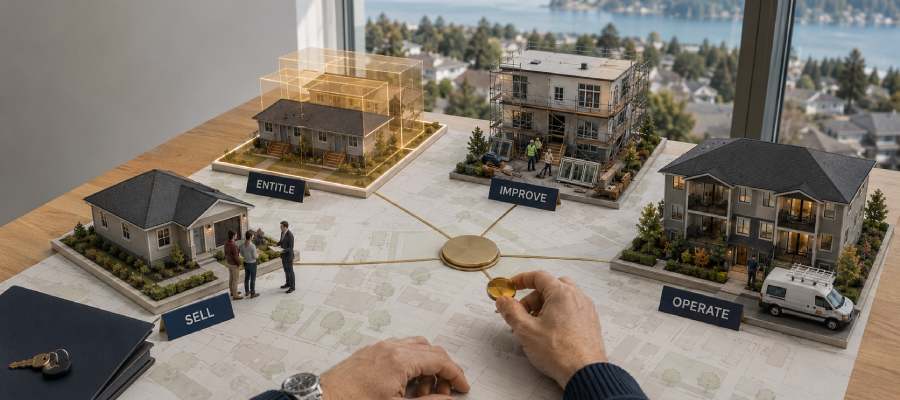
FolioProjects organizes that decision around four connected stages: entitle, improve, operate and sell. These are not four separate products or rigid boxes. They describe the principal ways an owner can create, protect or realize property value across a lifecycle.
A property can be operated while an entitlement is investigated. It can be improved before sale. It can be marketed while a buyer studies future development potential. The purpose of choosing a primary next stage is not to pretend that only one activity exists. It is to decide where owner attention, capital and intervention should be directed now.
Table of contents
A portfolio is a competition for resources
Each property competes for a limited amount of capital, borrowing capacity, time, professional support and owner attention. Treating properties as unrelated files conceals that competition.
An owner may spend $50,000 renovating a stable rental because the work is visible and easy to understand, while leaving a more valuable subdivision question unanswered on another asset. A persistent operating problem may consume months of attention even though selling that property would release capital for a stronger opportunity. A speculative rezoning may attract excitement while a simple permitted improvement elsewhere offers a faster and more reliable return.
The properties do not need to be physically similar to be compared. A duplex, small industrial building, vacant parcel and retail unit can all be evaluated against the owner’s goals. The comparison is not based on square footage or property type alone. It is based on what each asset can contribute, what it requires and what may happen if the owner does nothing.
This makes inaction a decision as well. Deferring an entitlement study can mean losing time before a policy change or sale. Delaying a repair can increase damage, vacancy or insurance risk. Leaving a well-performing property alone can be the correct choice when it preserves income and avoids unnecessary capital spending. Continuing to hold a weak asset has an opportunity cost even when no new invoice appears.
Portfolio planning should make these trade-offs visible. The owner needs to know which asset is creating value, which is protecting value, which is consuming resources and which requires intervention before the available options narrow.
Begin with the owner’s goal, not the property category
The same property can require a different next move for different owners.
A duplex may be an operating-income asset for one owner, a strata-conversion opportunity for another and a near-term sale for an owner approaching retirement. A small industrial building may be worth improving for a long-term holder but sold as-is by an owner who needs liquidity for a larger acquisition. A vacant parcel may justify a multi-year entitlement process for an experienced developer while representing unacceptable time and approval risk for someone else.
The property does not choose the strategy. The owner’s goal gives the facts their meaning.
A useful goal identifies the intended outcome, time horizon and constraints. Is the priority current cash flow, long-term appreciation, reduced owner involvement, tenant retention, risk reduction, refinancing, estate planning, geographic consolidation or sale? How much capital is available? How much uncertainty can the owner carry? Is the property expected to support the owner’s income today or create a larger future gain?
The goal also defines what should trigger intervention. If the goal is stable income, declining tenant sentiment and unresolved repairs matter immediately. If the goal is a sale within twelve months, missing permits, incomplete maintenance records and an untested buyer narrative may deserve priority. If the goal is to increase density, an unanswered servicing question may be more important than a cosmetic renovation.
Without that hierarchy, every finding becomes another task. With it, the owner can distinguish work that advances the goal from work that merely creates activity.
What entitle, improve, operate and sell actually mean
The four stages describe different owner outcomes. They also require different evidence and different qualified professionals.
| Primary next move | Owner objective | Evidence that usually matters | The result the owner is trying to create |
|---|---|---|---|
| Entitle | Confirm or change what the property may legally become | Zoning, policy, title, servicing, concept plans, authority feedback, studies, costs and stakeholder response | More certain or more valuable development and ownership options |
| Improve | Change the physical asset or its performance | Condition findings, scope, estimates, permits, rebates, financing, schedule, completion evidence and measured outcomes | Reduced risk, better utility, income, durability, comfort or sale readiness |
| Operate | Protect value and produce the intended ongoing result | Income, expenses, leases, maintenance, manager updates, tenant sentiment, inspections, compliance and unresolved findings | Reliable performance with exceptions reaching the owner in time |
| Sell | Realize value and reallocate capital | Market evidence, property record, disclosures, buyer sentiment, sale costs, tax and financing implications, competing uses of proceeds | A completed disposition on terms that support the owner’s larger plan |
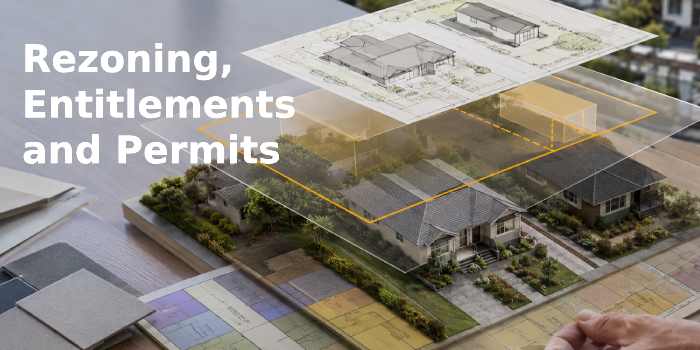
Entitle is broader than rezoning. It includes confirming existing rights and investigating approvals such as zoning changes, variances, development permits, subdivision or strata conversion. The owner is trying to create lawful and economically useful optionality, not simply collect approvals.
Improve includes repairs, renovations, additions, building-system upgrades, energy work, accessibility, risk reduction and construction. A successful improvement is not measured only by completion. It should produce the intended result at an acceptable cost, with evidence that can support future operation, insurance, financing and sale.
Operate does not mean keeping the property unchanged forever. It means the property’s current purpose is producing value and should be governed accordingly. The owner delegates daily work where appropriate while retaining the facts needed to determine whether management, maintenance and tenant outcomes are supporting the goal.
Sell is not a failure of the other stages. It is how property value is realized and capital is moved. A disciplined owner can sell a strong asset because the market is paying more for its future than the owner wishes to spend creating it. The same owner can hold a weaker-looking asset because its income, location or development options fit the portfolio better.
The evidence needed before choosing the next move
The next stage should not be selected from a dashboard label alone. It should be supported by an evidence chain that explains the asset today and the assumptions behind the proposed action.
The record begins with ownership, title, use, zoning, physical condition, tenancy, income, expenses, debt, insurance and known obligations. It should identify material systems, deficiencies, permits, warranties, unresolved claims and recurring maintenance. It should also preserve the conclusions of planners, architects, engineers, property managers, contractors, brokers, appraisers, accountants, lawyers and other specialists without treating every opinion as a confirmed fact.
Evidence quality matters because the four choices can appear attractive for different reasons.
Entitlement potential can be overstated by a listing description that ignores servicing or approval risk. An improvement can appear profitable because the estimate excludes design, permits, vacancy or financing. Operations can look stable because a manager’s report records activity without measuring tenant experience or repair outcomes. A sale estimate can look compelling before transaction costs, tax, deferred maintenance and the use of proceeds are considered.
The owner does not need perfect information before acting. The owner needs to know which facts are confirmed, which remain assumptions and which missing answer could materially change the decision.
That distinction is central to FolioProjects. AI can propose classifications, findings, risks and next steps, but the record should preserve provenance and allow the owner or qualified professional to confirm consequential facts. The purpose is not to manufacture certainty. It is to make uncertainty visible and actionable.
When entitlement should come next
Entitlement deserves priority when a change or confirmation of property rights offers meaningful value and the next uncertainty can be investigated at a reasonable cost.
The opportunity may involve adding units, changing use, increasing density, subdividing land, converting an existing building to strata or confirming that a proposed use is already permitted. In each case, the owner should define the desired property outcome before choosing an approval path.
The Government of British Columbia explains that zoning bylaws regulate how land, buildings and structures may be used, while other bylaws and development permit areas can add further requirements. This is why unused zoning capacity is not automatically buildable capacity. Title conditions, access, setbacks, environmental constraints, servicing, building code, financing and market demand still matter. See the provincial overview of local government land-use regulation.
Entitlement should move forward when the owner can identify the next value-changing question. A pre-application response may clarify whether rezoning is required. A survey may determine whether subdivision geometry works. A servicing review may reveal whether additional density is practical. A concept plan may show that the theoretical rights cannot fit on the site.
The initial objective is often not final approval. It is a better decision about whether to spend more.
Entitlement should be delayed or dropped when the approval path conflicts with the owner’s time horizon, the cost of resolving uncertainty is disproportionate, the resulting project remains uneconomic or another property offers a stronger use of the same resources. The reason should remain in the lifecycle record. A project rejected today may become relevant after a policy, market or ownership change.
When improvement should come next
Improvement deserves priority when a physical change can protect value, resolve an operating failure, support the intended use or create a credible return.
Some improvements are defensive. Water entry, electrical risk, failed building components and safety findings can become more expensive when delayed. Others are operational. A unit renovation may reduce turnover time, improve tenant comfort or support achievable rent. Some prepare the property for refinancing or sale. Others make a future entitlement physically or economically possible.
The correct scope should follow the property goal. A long-term owner may choose durable materials and building-system work that lowers lifecycle cost. An owner preparing to sell may complete high-confidence repairs and documentation while avoiding speculative work that a buyer may not value. A property facing operational complaints may need diagnosis and outcome verification more than a cosmetic upgrade.
Permits and incentives can alter the decision. British Columbia notes that construction and major renovations may require permits to confirm compliance with building, land-use, health and safety requirements. The province also maintains information on rebates and other financial incentives for qualifying work. See building or renovation permits and financial incentives for building and renovating.
Rebate information has value because owners with dispersed properties should not need to independently monitor every changing program in every jurisdiction. A rebate should not create the project by itself, but it can improve the economics or timing of work that already supports the goal.
The improvement record should connect the finding to the approved scope, price, signer, schedule, permits, progress evidence, completion evidence, warranty and real-world result. A paid invoice proves that money was spent. It does not prove that the original problem was resolved or that the expected value was created.
When operation should remain the priority
Operation is the correct primary stage when the property already serves its intended purpose and the best decision is to protect that performance.
This can be the least dramatic and most profitable choice. A stable asset with sound systems, satisfied tenants, understandable expenses and reliable income may not need a new development story. It may need disciplined maintenance, timely evidence and limited owner intervention.
The owner should still test whether delegated operations are producing the expected result. Property-management and accounting systems support daily work, but the owner needs an independent lifecycle record that remains available when managers, contractors, tenants and software change.
British Columbia’s consumer guidance recognizes that a property-management service agreement defines the manager’s authority and the records or responsibilities expected within the relationship. Owners can delegate different levels of repair and operating authority. The agreement therefore provides important context when evaluating whether performance matches instructions. See the BCFSA Consumer Guide to Tenancies and Consumer Guide to Service Agreements.
Tenant sentiment adds evidence that operational systems often miss. It does not replace an inspection, lease or professional conclusion. It reveals whether the people affected by repairs, communication and property conditions are experiencing the result the owner was told to expect.
HueFlux connects structured stakeholder responses to the relevant property, project, lifecycle stage and owner goal. It is not a public star-rating system. It helps identify a divergence that may require evidence or intervention.
Owner intervention required: Tenant sentiment is declining, two recurring repair findings remain unresolved, and the property manager has not supplied acceptable completion evidence. Request corrective action by Friday and confirm whether the current operating plan remains appropriate.
Operation remains the primary strategy until the evidence shows that another stage can create more value, or that operating problems have made improvement or sale the better choice.
When selling becomes the better allocation decision
Selling should be considered when the market will pay enough for the asset and its potential to justify giving up the future income and options, or when the owner’s capital and attention can produce a better result elsewhere.
This decision is broader than asking whether the property has increased in price. The owner should consider current income, expected capital requirements, debt, tax, transaction costs, management burden, geographic fit, concentration risk, unresolved liabilities and the realistic use of sale proceeds.
A property may be a sell candidate because its remaining upside requires expertise, time or capital the owner does not want to provide. Another may be sold after entitlement because a developer will pay for the de-risked opportunity. A well-operated asset may command a premium because the buyer can verify income, maintenance and tenant history. A weak property may still deserve improvement before listing if a defined repair removes a major buyer objection.
Sale preparation therefore begins before the listing. The lifecycle record can preserve permits, repairs, leases, systems, warranties, operating history, entitlement work, project decisions and other facts that help a buyer understand the asset. A Property Intelligence Snapshot can organize selected evidence for sharing without surrendering the owner’s complete private record.
Buyer sentiment supplies another form of outcome evidence. Showing activity and generic feedback do not necessarily explain why qualified buyers hesitate. Structured responses tied to price, condition, use, financing or future potential can help the owner determine whether the sale strategy is producing the intended result.
The province’s guidance on selling a rental property and BCFSA’s tenancy guidance illustrate why a tenanted sale can also carry operating and legal obligations. FolioProjects does not determine those obligations. It keeps the relevant goals, expert updates, evidence and stakeholder outcomes connected while the owner and licensed professionals conduct the transaction.
Selling is the right move when the net result advances the portfolio goal better than holding, improving or pursuing additional rights. The decision should specify what happens next to the capital. Otherwise, a sale can solve one property problem while creating a portfolio allocation problem.
How to compare different properties without false precision
Owners often want a single score that ranks every property. A score can help filter attention, but it can also hide the assumptions that make the ranking useful.
A property with large potential value may rank highly even though approval probability is low and the owner cannot finance the project. A stable property may appear unexciting while producing the portfolio’s most dependable cash flow. A repair-heavy asset may look weak until a modest capital project resolves the main risk. A sale candidate may appear attractive only because transaction costs and taxes have been excluded.
The comparison should preserve separate dimensions rather than compressing everything too early.
| Decision dimension | Owner question |
| Goal alignment | Does the proposed action support what I need this property and portfolio to accomplish? |
| Current value | What is the asset worth and producing under confirmed conditions today? |
| Projected value | What result is reasonably expected from the planned and funded action? |
| Potential value | What additional upside could exist if uncertain approvals or strategies succeed? |
| Downside and urgency | What value, income, safety or optionality may be lost if I wait? |
| Capital requirement | What cash, debt capacity and contingency does the next step require? |
| Time and dependencies | Which experts, approvals, people or events control the schedule? |
| Evidence confidence | Which assumptions are confirmed, disputed, stale or still unanswered? |
| Owner involvement | How much attention and intervention will the strategy require? |
| Reversibility | Can the owner pause or change course without destroying value? |
Current, projected and potential value should remain visibly separate. Potential value is useful for deciding where to investigate. It is not current equity and should not be presented as though every approval, cost and market assumption has already been resolved.
FolioProjects lets the owner review the whole portfolio or a chosen scope, such as properties in one province, one asset type, one lifecycle stage or one risk category. The purpose of the filtered view is to answer a decision question. Which British Columbia properties may qualify for a particular rebate? Which assets have unresolved safety findings? Which entitlement projects are waiting on the owner? Which operating properties show declining sentiment? Which sale candidates lack buyer-ready evidence?
The system should preserve how each answer was produced. A useful insight leads back to the property, goal, evidence and responsible person. The owner should be able to challenge the conclusion rather than accept a number generated by an opaque model.
Turn portfolio planning into an evidence-based review rhythm
Portfolio strategy should not be recreated from memory every time the owner has cash available or a problem becomes urgent.
Each property should have a current goal, a primary stage, the next value-changing question, the evidence needed to answer it, the responsible person and the date when the owner should review the result. Stable properties may require infrequent review. Active entitlement, construction, operating-failure or sale projects may require closer checkpoints.
The owner’s review can begin with five questions:
-
What changed across the portfolio since the last review?
-
Which properties are moving toward their goals, and what evidence confirms that movement?
-
Which assets are consuming capital or attention without reducing uncertainty or creating value?
-
Where is a deadline, unresolved finding or stakeholder response creating a need to intervene?
-
Which property now offers the best next use of available capital?
This is also where goal-based progress becomes a useful form of gamification. Progress should not reward the owner for opening the app, uploading random files or completing low-value tasks. It should show that important uncertainty was resolved, evidence was confirmed, risk was reduced, a milestone was achieved or a real-world outcome moved closer to the owner’s goal.
A good portfolio view makes the exception difficult to miss.
Owner intervention required: The rezoning project is waiting on a servicing answer, the planned roof replacement has exceeded its decision deadline, and one operating property shows declining tenant sentiment. Resolve these three exceptions before allocating the next round of capital.
The owner can then continue delegating the underlying work. Planners use planning tools. Contractors use project and field systems. Property managers use operational software. Brokers use transaction platforms. FolioProjects retains the goals, selected facts, evidence, sentiment, decisions and outcomes that allow the owner to understand the property across every stage.
Frequently asked questions
Does every property need to be assigned to only one stage?
No. A property can be operated while entitlement is investigated or improved while it is prepared for sale. Identifying a primary next stage simply clarifies which outcome deserves owner attention and capital now. Supporting activities can remain visible without competing equally for priority.
Is “operate” just the default when I do not know what to do?
It should be a deliberate strategy. Operation means the property’s current use supports the owner’s goal and the available evidence justifies protecting that performance. If the owner lacks enough information to choose, the next action may be a targeted assessment rather than passive holding.
Should I always entitle a property before selling it?
No. Entitlement can reduce uncertainty and increase buyer interest, but the time, cost and approval risk may not be worthwhile. In some cases, a buyer will pay for the opportunity and assume the process. Compare the likely net sale result with and without further entitlement work.
How do I decide which improvement to fund first?
Prioritize work that addresses urgent safety or deterioration, protects income, satisfies a required dependency or creates a well-supported return. Compare the consequence of delay, total project cost, evidence confidence and relationship to the property goal. Do not rank improvements only by visibility.
When should a stable property be sold?
Stability does not automatically mean hold. A strong property may attract a price that exceeds the owner’s value from continued ownership, or its capital may be more useful elsewhere. Consider net proceeds, replacement opportunities, tax, financing, income loss, management effort and the owner’s time horizon with qualified advisers.
Can FolioProjects tell me what my property is worth?
FolioProjects can organize evidence, assumptions, professional opinions and value scenarios. It should distinguish current, projected and potential value and show what supports each figure. It does not replace a qualified appraisal, broker opinion, lender assessment or market due diligence.
Does FolioProjects replace my planner, contractor, property manager or broker?
No. Those professionals perform licensed, technical and operational work at different stages. FolioProjects is the owner-controlled goal, evidence, insight and lifecycle layer that connects their updates to the property and the real-world result.
Give every property a clear next move
A portfolio should not become a collection of unrelated documents, urgent messages and attractive possibilities.
Each property needs a goal. Each goal needs evidence. Each stage needs a result the owner can verify. The portfolio view should reveal where capital can create the most value, where inaction creates risk and where owner intervention is required.
FolioProjects helps owners entitle, improve, operate and eventually sell property around their goals while maintaining one independent lifecycle record across every stage.
Start with a property, review the sample Property Intelligence Snapshot, explore a Portfolio Review, or see FolioProjects pricing.
See current value, projected value, potential value, risks and required interventions across your portfolio.
FolioProjects provides informational support, owner oversight and property lifecycle intelligence. It does not provide legal, planning, real estate, appraisal, tax, accounting, engineering, construction, insurance, lending or financial advice. Confirm consequential decisions with appropriately qualified professionals and the applicable authorities.
Sources and further reading
-
Government of British Columbia: Local government land-use regulation
-
Government of British Columbia: Building or renovation permits
-
Government of British Columbia: Financial incentives for building and renovating
-
Government of British Columbia: Condition inspections during tenancy
Turn the lifecycle decision into an actionable record
For each property, document the current objective, the supporting evidence, unanswered questions, and the next decision. A property may move from acquisition review to improvement and then operations without losing the earlier history.
Related reading: Is Your Property Manager Actually Doing a Good Job? The Evidence an Owner Should See Rezoning, Entitlements and Permits: What Property Owners Are Actually Trying to Change Understanding the Key Differences: Portfolio vs. Project vs. Program.
For owners managing this work, FolioProjects supports property records and portfolios organized around objectives such as Acquire, Entitle, Improve, Operate, or Divest. Explore FolioProjects pricing or learn how to set up a property.