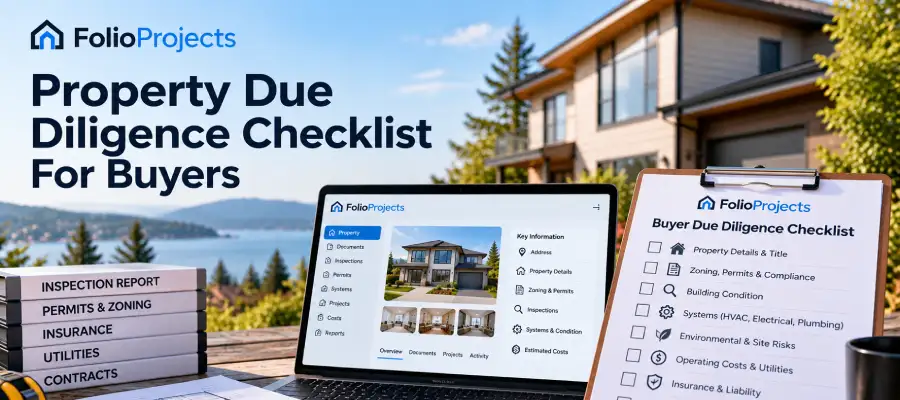
A practical property due diligence checklist covering ownership, building condition, permits, leases, operating costs, and unanswered questions.
Start with the decision, not the paperwork
Due diligence is the process of testing whether a property matches your intended use, budget, risk tolerance, and timeline. A document collection is useful only when it helps you reach a decision. Begin with the intended use of the property and write down the conditions that would cause you to renegotiate or walk away.
Write down what would change your decision
Before reviewing a large document package, define the intended use and the assumptions that make the purchase attractive. An owner-occupier may prioritize occupancy, financing, insurability and immediate repairs. A rental investor also needs to verify sustainable income, lease obligations and upcoming capital expenditures. A buyer intending to renovate or develop must pay particular attention to lawful use, servicing, approvals and the cost of achieving the proposed outcome.
Separate your questions into three groups: facts that must be verified before conditions are removed, issues that could justify a price adjustment or additional protection, and work that can reasonably be scheduled after closing. Do not treat the third group as permission to defer an unresolved safety or legal concern.
For example, a duplex may appear attractive based on advertised rent from both units. If one suite's legal status is unclear, the underwriting assumption should be marked unverified. The next action is to obtain appropriate municipal records and professional advice, not to assume the income is secure.
Build your own list: Use the free Property Due Diligence Checklist Builder to select the property type and track each question through to verification.
Verify the property and its legal status
Confirm the legal description, title, registered charges, access rights, easements, and any relevant strata documents. Compare the marketed property with the actual parcel and improvements. A listing description is not a substitute for title records or local-government records. Engage a qualified professional where title, boundaries, or legal use is uncertain.
Separate marketing claims from registered rights
Compare the civic address, parcel identifier, legal description and improvements described in the sale materials. A listing may describe a parking area, shared driveway or additional structure without explaining the rights or restrictions affecting its use. Request current records and ask the appropriate professional to interpret material entries.
For strata properties, examine the governing documents, recent meeting minutes, financial statements, budgets, depreciation information where available, insurance coverage and notices of proposed or approved levies. A low monthly fee is not evidence that the building is adequately funded. The relevant question is whether expected obligations and upcoming projects are understood.
Example decision issue: The seller states that the rear lane provides permanent access, but the buyer cannot identify the relevant legal right. Mark the access question as an issue, assign it to the legal advisor and record the response deadline. Do not change the status to verified merely because a seller's email was received.
Review the building and its systems
Request available inspection reports, maintenance records, equipment ages, warranties, and documentation for major renovations. Inspect the roof, envelope, drainage, electrical, plumbing, heating, ventilation, and life-safety systems as appropriate. Record each concern with its source, urgency, estimated investigation cost, and potential financial exposure. A professional inspection may be necessary.
Turn inspection observations into financial exposure
A building inspection is a starting point, not an exhaustive assessment of every concealed component. Review its limitations and any recommendation for specialist investigation. Record the affected system, observed condition, supporting evidence, recommended next action and a provisional cost range. Avoid converting a preliminary observation into a definitive diagnosis.
Consider a property with an aging roof, recurring moisture staining and uncertain drainage. A buyer might obtain a roofing assessment, investigate the source of moisture and seek a drainage opinion before making a decision. The resulting estimates may materially affect available capital after closing.
Use a simple triage system: urgent safety or legal concern, material near-term capital expenditure, ordinary maintenance, and information gap requiring investigation. The last category matters because an unknown cost can be as consequential as a confirmed defect.
For long-term ownership, link confirmed improvements and deficiencies to a capital plan. See how to track capital improvements on investment properties and the Capital Expenditure Planner.
Check permits and permitted use
Ask the relevant authority about zoning, building permits, final inspections, occupancy, and any outstanding orders. Do not assume an existing suite or conversion is authorized because it has been occupied for years. Requirements vary by jurisdiction and property type. Keep the supporting correspondence with the property record.
Ask what has been approved, not only what exists
Buildings can contain additions, secondary suites, conversions or commercial uses that do not match current municipal records. A property's physical existence does not establish its legal status. Request available permits, final inspections, occupancy records and correspondence concerning outstanding orders or deficiencies. The appropriate municipal department can explain what its records show, but the buyer may still need professional interpretation.
Distinguish four states in the checklist: claimed by seller, document received, reviewed with relevant authority or advisor, and remaining uncertainty. This avoids a common due diligence error: marking an issue complete because a PDF has arrived, even though it raises new questions.
For vacant land or development purchases, review zoning, setbacks, servicing, access, environmental constraints and the status of proposed entitlements. An application, a conditional approval and an issued permit are not interchangeable.
Understand income and operating expenses
For income property, compare rent rolls with leases and actual deposits where available. Review taxes, insurance, utilities, repairs, service contracts, vacancies, and planned capital expenditures. Distinguish documented figures from seller estimates. Stress-test the purchase against vacancy, insurance increases, and near-term major repairs.
Rebuild the operating picture from source records
For an income property, ask for a rent roll, leases, payment history, operating statements, property tax information, insurance details, utilities and material service agreements. Compare the documents rather than relying on one summary. If reported rent differs from signed leases or actual collections, document the discrepancy and its explanation.
Suppose a property is marketed at $72,000 in annual gross rent but records indicate $3,000 in concessions and $2,400 in unpaid amounts. The buyer should investigate whether the advertised figure represents contractual rent, actual collections or a stabilized projection. These figures answer different questions.
Build a near-term capital budget separately from ordinary annual operating expenses. An attractive current cash flow can coexist with a roof replacement, mechanical upgrade or major building-envelope project that requires significant funding. Obtain insurance indications early enough to address coverage exclusions or mandatory improvements.
When analyzing commercial property, also examine lease options, recoverable expenses, tenant improvements, repair obligations and unusual termination rights. Have qualified advisors review legal and accounting interpretations.
Maintain an unanswered-questions register
Create a short register containing the question, responsible party, supporting evidence, deadline, and decision impact. An unresolved question is not automatically a deal breaker, but it should not disappear into an email thread. Revisit the register before removing conditions or committing additional funds.
Use a consistent evidence and decision register
Every material question should identify the person responsible for obtaining an answer, the evidence requested, the response deadline, its current status and the consequence if unresolved. A useful set of statuses is Not started, Requested, Received, Verified, Issue, and Not applicable. Receiving information is not the same as verifying it.
| Question | Evidence needed | Status | Decision impact |
|---|---|---|---|
| Is the secondary suite authorized? | Municipal permit and occupancy records | Requested | Income assumption remains uncertain |
| What is the roof's remaining life? | Inspection and roofing assessment | Issue | May require near-term capital |
| Are tenancy terms documented? | Signed leases and payment history | Verified | Supports income review |
Illustrative entries only. Actual verification requires review of the relevant source evidence.
Download the Due Diligence Workbook (Excel) to maintain a structured checklist, open-questions register and progress summary. For a printable starting point, use the Property Due Diligence Checklist (PDF).
Turn the findings into an action plan
Separate issues into immediate conditions, first-90-day actions, and longer-term capital projects. FolioProjects can help organize property documents, findings, projects, and an Acquire Snapshot so the assessment remains useful after the transaction. It does not replace legal, financial, engineering, or inspection advice.
Prepare a decision memo before conditions are removed
Summarize the verified facts, material uncertainties, expected near-term expenditures and items that require a specialist opinion. Record whether the issue changes the intended use, financing, insurability, legal exposure or total cost of ownership. A clear summary is more useful than a large folder of unreviewed documents.
For example, a buyer might accept an aging heating system after obtaining a replacement estimate and reserving the necessary funds. The same buyer might decline to proceed when legal access or intended occupancy remains unresolved. The appropriate response depends on the facts, contractual conditions and professional advice, not an automated checklist score.
After closing, transfer relevant records into a persistent property information system rather than abandoning the due diligence package. Inspection findings can become maintenance actions; planned replacements can become capital projects; warranties and permits can remain attached to the property. FolioProjects' Acquire Snapshot is designed around this continuity between purchase evaluation and ownership.
Final review: Before removing purchase conditions, confirm that material outstanding questions have been resolved or explicitly addressed with your legal and other professional advisors. A checklist cannot determine whether a property is safe, legally compliant or a sound investment.
Next step: Explore FolioProjects pricing and learn how to set up a property.